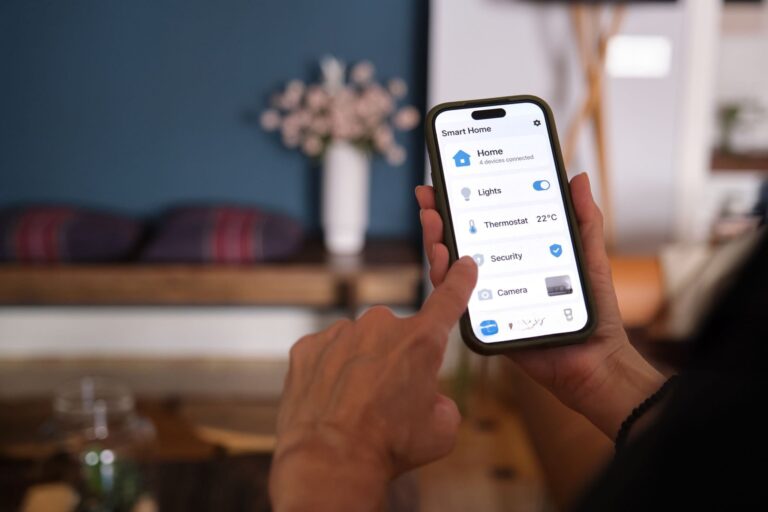
If you’re exploring smart home technology, you’ve probably come across the term smart home hub. It’s often mentioned alongside lighting control, automation scenes, and whole-home systems, but what does it actually do?
A smart home hub is the central control point for your home automation system. Instead of managing multiple devices through separate apps, a hub connects and coordinates everything in one place. Lighting, climate, audio, security, blinds, and access control all communicate through the hub, allowing your home to operate as a single, intelligent system.
In short, the smart home hub is what turns a collection of connected devices into a truly smart home.
Why a smart home hub matters
Without a hub, smart devices tend to operate in isolation. You might control lights through one app, audio through another, and security through a third. While each device may work well on its own, the experience quickly becomes fragmented.
A smart home hub solves this by:
- Creating a single, intuitive interface
- Enabling automation and scenes across systems
- Improving reliability and performance
- Making the system easier to use and maintain
For homeowners, this means less friction, less complexity, and a far more enjoyable living experience.
How a smart home hub improves everyday life
One interface, complete control
With a smart home hub, everything is controlled from one place. That could be a wall-mounted touch panel, a smartphone app, or voice control. Instead of remembering which app controls which function, you get a unified experience that feels natural and easy.
Want to adjust the lighting, turn on music, and set the temperature before guests arrive? It’s all done in a few taps.
Automation that works in the background
A hub allows your home to respond automatically to your routine. For example:
- Lights dim and blinds close in the evening
- Climate adjusts based on time of day or occupancy
- Security arms automatically when you leave
- Outdoor lighting turns on at sunset
These automations run quietly in the background, reducing the need for manual control and making your home feel intuitive.
Better security and peace of mind
When security systems are connected through a smart home hub, they become part of a wider safety ecosystem. Motion sensors, cameras, door locks, and lighting can all work together.
If motion is detected at night, lights can turn on automatically. If the front door opens, you can receive an alert and view the camera feed instantly. Everything is coordinated and easy to monitor.
Energy efficiency without effort
Smart home hubs help reduce energy use by ensuring systems only operate when needed. Lighting turns off in empty rooms. Climate control adjusts based on occupancy and temperature. Blinds respond to sunlight to reduce heat gain.
The result is a more efficient home, lower running costs, and less energy wasted.
Types of smart home hubs
Not all smart home hubs are the same. The right choice depends on the size of your home, how integrated you want the system to be, and how you plan to use it over time.
Platform-based hubs
Platforms like Control4, Savant, Crestron, and KNX use powerful central controllers that manage every aspect of the home. These hubs are designed for full-home integration and professional installation.
They are ideal for:
- New builds and major renovations
- Homes with multiple systems to integrate
- Clients who want custom automation and scenes
- Long-term reliability and scalability
Consumer hubs
Consumer-focused hubs often rely on cloud-based services and WiFi-connected devices. They can be suitable for small setups but are limited in integration, reliability, and long-term flexibility.
While these hubs can work for basic control, they are not designed for complex, high-end homes or architectural integration.
Why planning your smart home hub early matters
For new builds, the smart home hub should be considered early in the design phase, not as an afterthought. This allows:
- Structured cabling to be installed before walls are closed
- Touch panels, keypads, and sensors to be positioned correctly
- Equipment to be concealed for a clean aesthetic
- Systems to be integrated without compromise
Retrofitting a hub after construction is possible, but it often involves additional cost and limitations. Early planning ensures the best outcome.
How Switch approaches smart home hubs
At Switch Home Automation, we don’t start with products. We start with people.
Our role is to understand how you live, how you want your home to feel, and what level of control suits your lifestyle. From there, we design a system around a smart home hub that supports those needs.
System design first
We design every system from the ground up, mapping technology to your floor plans, lighting layouts, and daily routines. The hub is chosen based on how your home needs to operate, not on brand popularity alone.
High-end, reliable platforms
We work with professional-grade smart home hubs that are proven, secure, and supported long term. These systems are designed to grow with your home and adapt as technology evolves.
We avoid low-quality, retail-grade solutions that can compromise performance or reliability.
Seamless installation and commissioning
Once the hub and systems are installed, we commission and program everything to work together. This includes automation logic, scenes, user interfaces, and performance tuning.
The result is a system that feels effortless to use from day one.
Ongoing support and optimisation
Your relationship with Switch doesn’t end at handover. As you live in your home, your needs may change. We fine-tune automations, add features, and provide ongoing support to keep your system performing at its best.
A smart home hub adds real value
A well-designed smart home hub doesn’t just improve daily living. It adds long-term value to your home.
- It increases appeal to future buyers
- It positions the home as modern and future-ready
- It reduces running costs through efficiency
- It enhances comfort, security, and convenience
In high-end homes, a professionally integrated smart home system is now seen as a premium feature, not a novelty.
Experience it for yourself
The best way to understand the impact of a smart home hub is to experience one in action. At our Rosebery showroom, you can see how lighting, audio, climate, and security work together through a central control system.
We’ll walk you through different platforms, explain the benefits of each, and help you choose the right solution for your home.
If you’re building or renovating and want to create a home that truly works for you, we’re here to help.
Book a showroom visit or speak with our team to explore what’s possible with a smart home hub designed by Switch.